
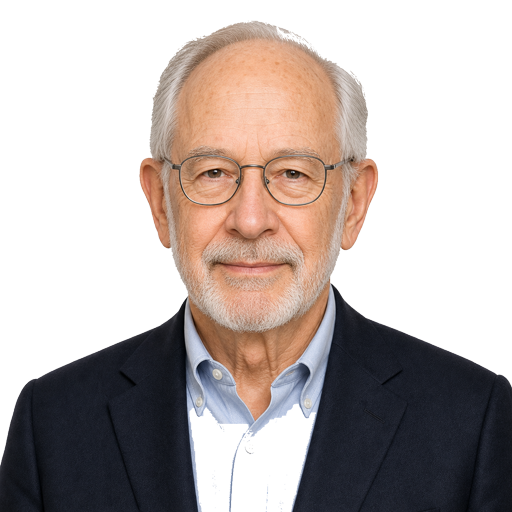
William Sharpe
Asset pricing, portfolio theory, CAPM, risk-adjusted performance measurement
William Sharpe developed the Capital Asset Pricing Model (CAPM) in the 1960s as an extension of Harry Markowitz's portfolio theory, providing a framework for pricing individual assets based on systematic risk (beta). He was awarded the Nobel Prize in Economics in 1990 along with Markowitz and Merton Miller. The Sharpe Ratio — measuring risk-adjusted return per unit of volatility — bears his name and is the most widely used performance metric in investment management. Sharpe has also contributed to work on financial engines for retirement and binomial options pricing. His Sharpe arithmetic — demonstrating that active managers in aggregate must underperform passive investors by exactly the amount of their fees, since they collectively hold the market — provides one of the most rigorous theoretical foundations for passive investing. Later in his career, Sharpe developed factor-based return attribution methods that became the basis for returns-based style analysis, allowing investors to decompose a fund's historical return into its exposure to systematic risk factors without requiring access to the fund's underlying holdings.

Person photos, portraits, descriptions, and market context may be AI-generated or AI-assisted and are not an official biography, identity verification, affiliation, or endorsement: legal notice.
Analytics
Instrument Influence
Loading influence...
Signal Sources
Loading sources...
Checking access...