
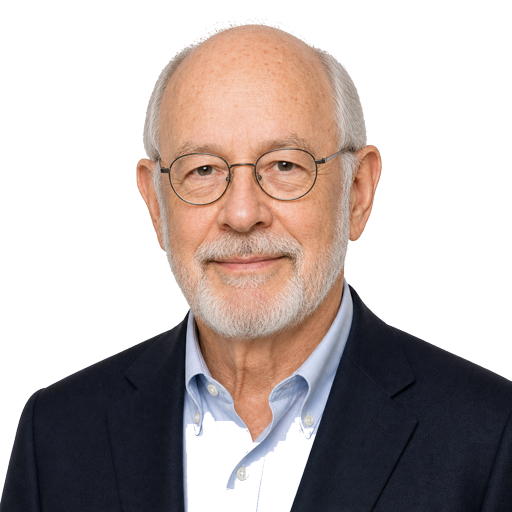
William F. Sharpe
Developed CAPM (1964) providing the first equilibrium asset pricing model; created the Sharpe ratio; Nobel Prize 1990; wrote foundational textbook Investments; co-founded Financial Engines.
William Sharpe received his PhD in economics from UCLA, where he was mentored by Harry Markowitz. In 1964, building on Markowitz's mean-variance framework, he published the Capital Asset Pricing Model (CAPM) — one of the most influential theories in financial economics. The CAPM argues that in equilibrium, the expected return on any asset is a linear function of its beta — its covariance with the market portfolio relative to market variance. This provides both a positive model of expected returns and a normative framework for evaluating whether an investment earns sufficient return for its systematic risk. The CAPM introduced beta as the standard measure of systematic risk, a concept that pervades investment management to this day. Sharpe also created the Sharpe ratio — the ratio of excess return to standard deviation — which became the universal standard for risk-adjusted performance evaluation of investment funds, portfolio managers, and trading strategies. Sharpe received the Nobel Prize in Economic Sciences in 1990 jointly with Markowitz and Miller. He later co-founded Financial Engines (now Edelman Financial Engines), an online investment advice platform that uses financial planning and optimisation algorithms to provide personalised asset allocation to retirement account holders — applying his academic work at mass-market scale. He has also contributed to the factor model literature and to the analysis of investment costs and their impact on long-term wealth accumulation.

Person photos, portraits, descriptions, and market context may be AI-generated or AI-assisted and are not an official biography, identity verification, affiliation, or endorsement: legal notice.
Analytics
Instrument Influence
Loading influence...
Signal Sources
Loading sources...
Checking access...