
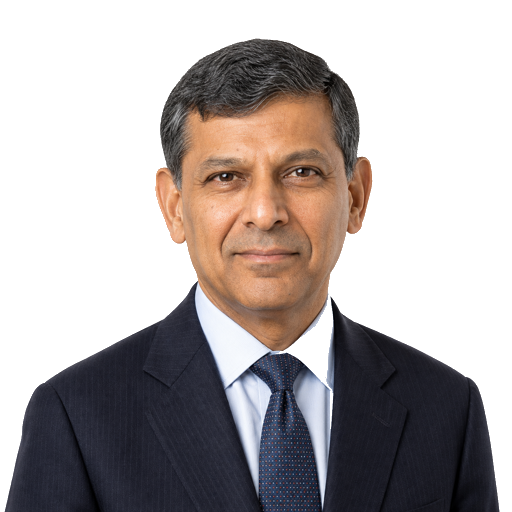
Raghuram Rajan
Predicted financial system fragility at Jackson Hole 2005; IMF Chief Economist 2003-2006; Governor Reserve Bank of India 2013-2016; wrote Fault Lines (2010) and Saving Capitalism from the Capitalists.
Raghuram Rajan received his MBA from IIM Ahmedabad and his PhD from MIT. He joined the faculty of the University of Chicago Booth School of Business, where he has been a professor of finance for most of his career. He served as Chief Economist of the International Monetary Fund from 2003 to 2006. At the Federal Reserve's annual Jackson Hole symposium in 2005 — a gathering of central bank governors, finance ministers, and leading economists — Rajan presented a paper titled "Has Financial Development Made the World Riskier?" arguing that the complexity of new financial instruments, combined with the incentive structures of financial managers, had created systemic fragility that was not adequately reflected in standard risk models. The paper was met with considerable scepticism from the audience, including former Treasury Secretary Lawrence Summers who characterised it as misguided. The 2008 financial crisis proved Rajan's analysis prescient. He wrote "Fault Lines" (2010), examining the structural factors — rising inequality, housing subsidies, and global imbalances — that he argued made the crisis inevitable. From 2013 to 2016 he served as Governor of the Reserve Bank of India, where he stabilised the rupee and rebuilt India's foreign exchange reserves. He is one of the most influential academic economists working at the intersection of financial regulation, monetary policy, and political economy.


Person photos, portraits, descriptions, and market context may be AI-generated or AI-assisted and are not an official biography, identity verification, affiliation, or endorsement: legal notice.
Analytics
Instrument Influence
Loading influence...
Signal Sources
Loading sources...
Checking access...