
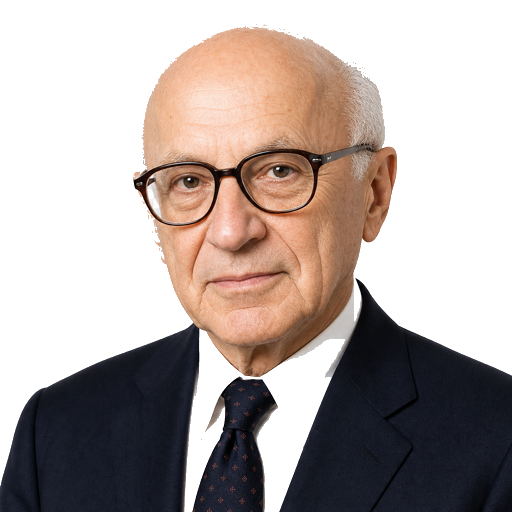
Milton Friedman
Nobel Prize 1976; monetarism became the basis for modern inflation targeting; Consumption Function and Permanent Income Hypothesis; A Monetary History of the United States (with Schwartz); shaped Chicago School.
Milton Friedman received his PhD from Columbia University and spent most of his career at the University of Chicago, where he became the central figure of the Chicago School of Economics — a tradition emphasising free markets, limited government, and monetarism. He is widely regarded as the most influential economist of the second half of the 20th century. His most influential theoretical work argues that inflation is "always and everywhere a monetary phenomenon" — that sustained inflation is driven by excessive growth in the money supply. This monetarist framework challenged the dominant Keynesian view that fiscal policy was the primary lever for economic stabilisation, and argued instead that stable, predictable monetary policy was the key to economic stability. The monetarist framework directly influenced the Federal Reserve's policy shift under Paul Volcker in 1979. Together with Anna Schwartz, Friedman co-authored "A Monetary History of the United States, 1867-1960" (1963), which demonstrated that the Federal Reserve's contraction of the money supply was a primary cause of the Great Depression's severity — a finding that directly shaped Ben Bernanke's academic research and crisis response. Friedman also contributed the permanent income hypothesis, the natural rate of unemployment, and the negative income tax to economic theory. He received the Nobel Prize in Economics in 1976. Beyond academia, Friedman was a passionate public advocate for free markets, writing "Capitalism and Freedom" (1962) and appearing in the popular television series "Free to Choose" (1980).

Person photos, portraits, descriptions, and market context may be AI-generated or AI-assisted and are not an official biography, identity verification, affiliation, or endorsement: legal notice.
Analytics
Instrument Influence
Loading influence...
Signal Sources
Loading sources...
Checking access...