
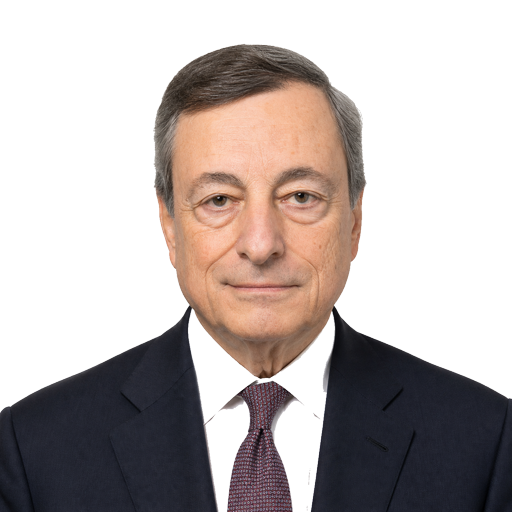
Mario Draghi
European monetary policy, sovereign debt crisis management, euro stability
Mario Draghi served as President of the European Central Bank from 2011 to 2019. His July 2012 speech in which he declared the ECB would do "whatever it takes to preserve the euro" — and his subsequent Outright Monetary Transactions (OMT) program — is widely credited with ending the European sovereign debt crisis. Draghi presided over the introduction of negative interest rates, quantitative easing for the eurozone, and major structural reforms to ECB operations. After leaving the ECB, he served as Prime Minister of Italy from 2021 to 2022 and later authored an EU competitiveness report. Before the ECB, he served as Governor of the Bank of Italy from 2006 to 2011 and as Vice President of Goldman Sachs Europe in the 1990s. He was educated at MIT where he completed his doctoral thesis under Stanley Fischer. His combination of academic rigor, central bank experience, and private sector background made him unusually well-equipped for the ECB's complex multi-stakeholder governance. The "Draghi Report" on European competitiveness, commissioned by the European Commission and published in 2024, became a landmark document advocating for deeper capital markets union, significant public investment, and regulatory streamlining as essential prerequisites for European economic competitiveness.


Person photos, portraits, descriptions, and market context may be AI-generated or AI-assisted and are not an official biography, identity verification, affiliation, or endorsement: legal notice.
Analytics
Instrument Influence
Loading influence...
Signal Sources
Loading sources...
Checking access...