
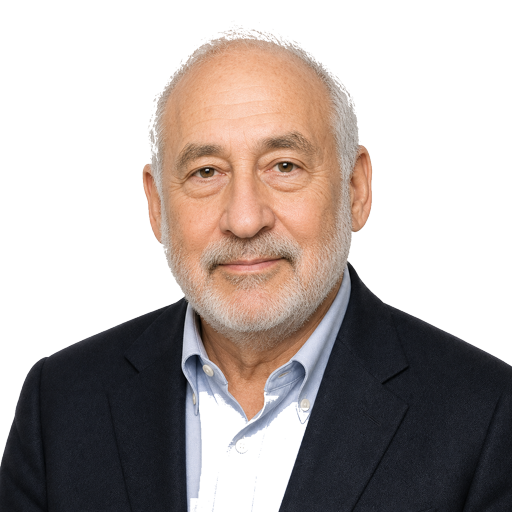
Joseph Stiglitz
Nobel Prize 2001; World Bank Chief Economist 1997-2000; Council of Economic Advisers Chair under Clinton; Globalization and Its Discontents (2002); foundational work on screening and signaling in insurance markets.
Joseph Stiglitz received his PhD from MIT and has taught at Yale, Princeton, Stanford, and Columbia. He shared the 2001 Nobel Prize in Economics with George Akerlof and Michael Spence for their work on information asymmetry. Stiglitz's particular contributions include foundational research on how competitive markets fail when information is asymmetric — showing that basic economic results (like the efficiency of competitive equilibria) break down when agents have different information. His work on 'screening' models (where firms design contracts to separate different types of customers) and 'signaling' models (where informed parties communicate their quality through costly actions) became central to microeconomic theory. He served as Chair of the Council of Economic Advisers under President Clinton and as Chief Economist of the World Bank from 1997-2000. He resigned from the World Bank amid controversy over his criticism of IMF austerity policies. His book 'Globalization and Its Discontents' (2002) argued that IMF and World Bank policies had increased poverty in developing countries. He has subsequently written extensively on inequality, financial regulation, and the 2008 financial crisis, becoming one of the most prominent advocates for reforming global economic governance.

Person photos, portraits, descriptions, and market context may be AI-generated or AI-assisted and are not an official biography, identity verification, affiliation, or endorsement: legal notice.
Analytics
Instrument Influence
Loading influence...
Signal Sources
Loading sources...
Checking access...