
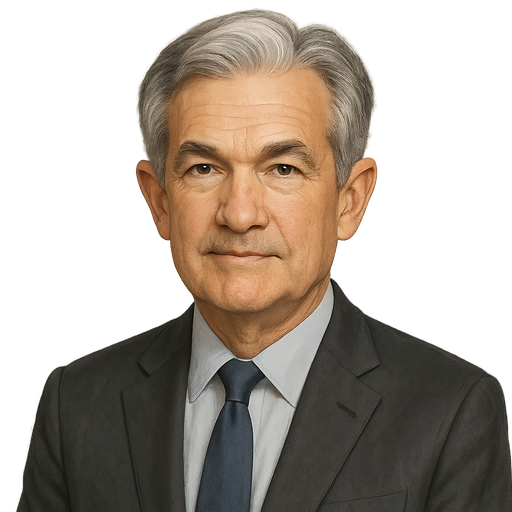
Jerome Powell
Navigated the fastest rate-hiking cycle in 40 years while achieving a rare "soft landing" — controlling 9% inflation without triggering recession
A lawyer and former private equity executive, Powell was appointed by President Trump and reappointed by President Biden, making him a rare bipartisan figure in American monetary policy. Powell's tenure has been defined by extraordinary challenges: the COVID-19 pandemic prompted the Fed to cut rates to zero and launch unlimited quantitative easing in March 2020, preventing a financial system collapse. When inflation surged to 9.1% in June 2022 — the highest in 40 years — Powell orchestrated the most aggressive tightening cycle since Paul Volcker, raising rates from 0% to 5.25-5.50% in 16 months while managing to avoid a recession (the "soft landing"). Every FOMC meeting, press conference, and congressional testimony by Powell is among the highest-impact events in global markets. His communication style — deliberate, data-dependent, and carefully hedged — has become a subject of intense parsing by traders, with individual word choices routinely moving trillions of dollars across stocks, bonds, currencies, and commodities. Powell's influence extends far beyond US borders: the Fed's rate decisions drive global capital flows, force other central banks to adjust their own policies, and set the effective price of money for the entire world economy. His management of the inflation crisis while preserving employment has been widely studied as a potential new template for central banking in an era of supply shocks and fiscal dominance.

New construction activity — lumber demand, construction jobs and residential real estate cycle signal.

Longest US government bond — generational inflation expectations, pension demand and fiscal sustainability.

Freshly built home demand — builder confidence, mortgage rates and suburban migration trends.

Services economy pulse — 80% of US GDP in a single survey, from healthcare to tech to restaurants.

Treasury sweet spot between belly and long end — popular auction maturity for foreign central banks.

Business investment intentions — capital goods orders revealing corporate confidence in future growth.
Person photos, portraits, descriptions, and market context may be AI-generated or AI-assisted and are not an official biography, identity verification, affiliation, or endorsement: legal notice.
Analytics
Instrument Influence
Loading influence...
Signal Sources
Loading sources...
Checking access...