
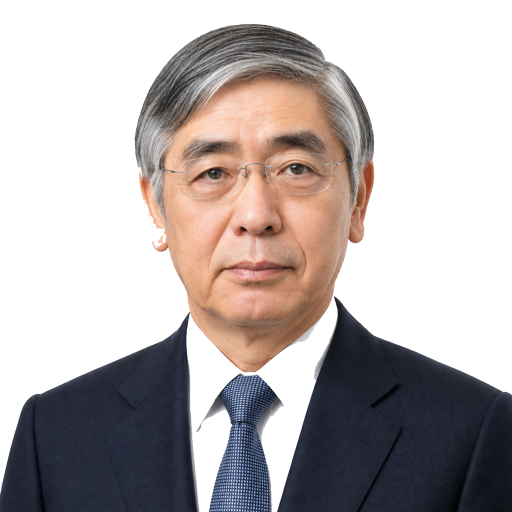
Haruhiko Kuroda
Bank of Japan policy, Abenomics, yield curve control, deflation management
Haruhiko Kuroda served as Governor of the Bank of Japan from 2013 to 2023, implementing the monetary pillar of Prime Minister Abe's "three arrows" policy. He launched massive quantitative and qualitative easing, expanding the BoJ's balance sheet to well over 100% of GDP. Kuroda also introduced yield curve control in 2016 — targeting a specific yield level for 10-year Japanese government bonds. These policies aimed to break Japan's deflationary psychology, with mixed results. Before the BoJ, he served as president of the Asian Development Bank from 2005 to 2013. Under his extreme easing, the Bank of Japan became the world's largest holder of Japanese government bonds and the country's largest shareholder by ETF purchases, owning shares in a majority of listed Japanese companies. The unprecedented scale of balance sheet expansion made the unwinding of these positions one of the most consequential monetary policy challenges facing his successors. His predecessor Masaaki Shirakawa had been more cautious about large-scale asset purchases, making Kuroda's appointment a signal of dramatically different priorities. His tenure ended in April 2023 when Kazuo Ueda succeeded him, inheriting the task of normalizing policy after a decade of unconventional accommodation.


Person photos, portraits, descriptions, and market context may be AI-generated or AI-assisted and are not an official biography, identity verification, affiliation, or endorsement: legal notice.
Analytics
Instrument Influence
Loading influence...
Signal Sources
Loading sources...
Checking access...