
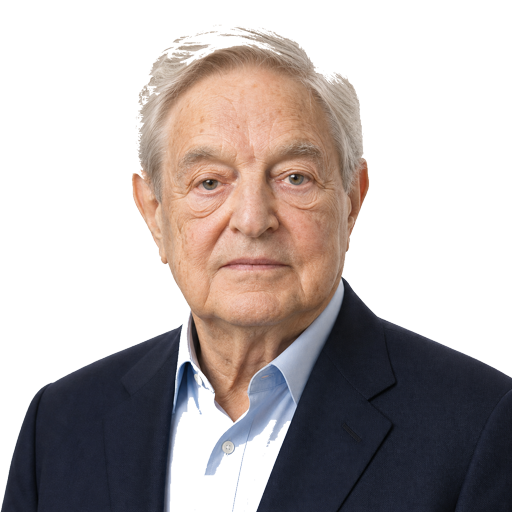
George Soros
Demonstrated that a single trader with sufficient conviction and capital can break a central bank — the 1992 sterling crisis redefined how markets perceive sovereign currency risk and the limits of fixed exchange rate regimes.
Born György Schwartz in 1930 in Budapest, Hungary, Soros survived the Nazi occupation before emigrating to England in 1947 where he studied at the London School of Economics under philosopher Karl Popper. Popper's concept of fallibility profoundly influenced Soros's investment philosophy, which he later formalized as reflexivity theory. After working at several London merchant banks, Soros moved to New York and eventually founded the Quantum Fund in 1973 with Jim Rogers. The fund compounded at approximately 30% annually for over two decades, making it one of the most successful investment vehicles in history. Soros turned $1,000 invested in 1969 into $4 million by 2000. His most famous trade came on September 16, 1992 — Black Wednesday — when he shorted £10 billion worth of sterling, forcing the Bank of England to withdraw from the European Exchange Rate Mechanism. The trade netted approximately $1 billion in profit for the Quantum Fund and earned Soros the title "the man who broke the Bank of England." Similar speculative attacks followed in Southeast Asian currencies during the 1997 Asian financial crisis. Soros developed reflexivity theory — the idea that market participants' biased views can influence market fundamentals, creating feedback loops that drive prices away from equilibrium. This contradicts efficient market theory and has become influential in behavioral finance. He laid out these ideas in The Alchemy of Finance (1987) and numerous subsequent books. Through the Open Society Foundations, Soros has donated over $32 billion to philanthropic causes, focusing on democracy, human rights, and education across more than 100 countries.

The world's risk-free rate — prices everything from mortgages to corporate bonds across the globe.

World's most traded pair: Fed vs. ECB policy, transatlantic capital flows and global reserve dynamics.
The world's most important equity index — 500 companies representing $40T+ in market capitalization.
Person photos, portraits, descriptions, and market context may be AI-generated or AI-assisted and are not an official biography, identity verification, affiliation, or endorsement: legal notice.
Analytics
Instrument Influence
Loading influence...
Signal Sources
Loading sources...
Checking access...