
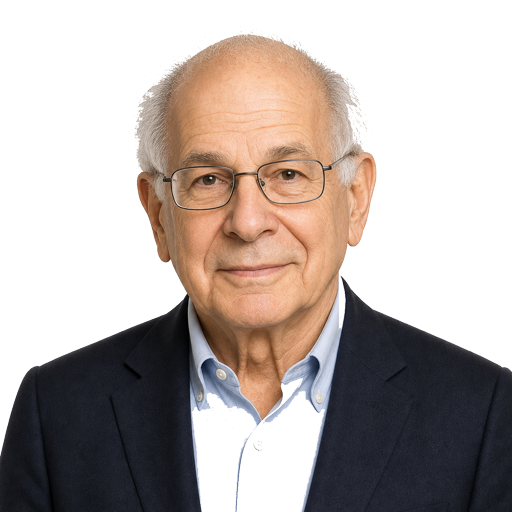
Daniel Kahneman
Co-developed prospect theory with Amos Tversky; Nobel Prize 2002; wrote Thinking, Fast and Slow (2011) — 10M+ copies sold; foundational work on cognitive biases in financial decision-making.
Daniel Kahneman is a psychologist by training who received the Nobel Prize in Economics — a remarkable recognition of how fundamental his work on human decision-making is to economic and financial theory. Working with his long-time collaborator Amos Tversky, Kahneman developed prospect theory (published in Econometrica in 1979), which provides an empirically grounded descriptive model of how people actually make decisions under uncertainty. Prospect theory departs from expected utility theory in several important ways: it uses a value function defined over gains and losses (not absolute levels of wealth) that is concave for gains and convex for losses — capturing loss aversion, the empirical finding that losses loom roughly twice as large as equivalent gains. It also uses a probability weighting function that overweights small probabilities and underweights large ones. Prospect theory has been foundational for behavioural finance, explaining phenomena including the equity premium puzzle, the disposition effect, and the popularity of lottery-like securities. Kahneman and Tversky also catalogued numerous cognitive biases — anchoring, availability heuristic, representativeness heuristic, overconfidence — that systematically affect investment decisions. Kahneman's bestselling book "Thinking, Fast and Slow" (2011), which has sold over 10 million copies, popularised the two-system model of cognition for a broad audience. He was awarded the Presidential Medal of Freedom in 2013. Kahneman passed away in March 2024.

Person photos, portraits, descriptions, and market context may be AI-generated or AI-assisted and are not an official biography, identity verification, affiliation, or endorsement: legal notice.
Analytics
Instrument Influence
Loading influence...
Signal Sources
Loading sources...
Checking access...