
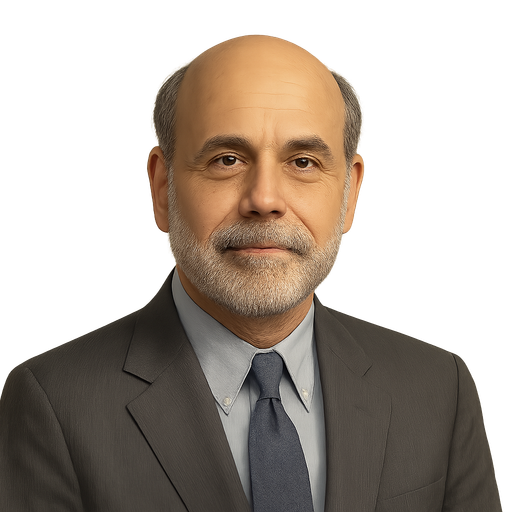
Ben Bernanke
Federal Reserve crisis policy, quantitative easing invention, Great Depression research, US monetary policy framework, global central bank communication standards
Ben Bernanke served as Chairman of the Federal Reserve from 2006 to 2014. His academic research on the Great Depression — arguing that bank failures had transmitted and amplified the economic shock — directly influenced his policy response during the 2008 crisis. He dramatically expanded the Fed's balance sheet through quantitative easing (purchasing Treasury bonds and mortgage-backed securities), a historically unprecedented action. He also established forward guidance as a key Fed communications tool. He received the 2022 Nobel Prize in Economics (with Douglas Diamond and Philip Dybvig) for research on banks and financial crises. He subsequently joined Brookings Institution and PIMCO as a senior adviser. His academic work, particularly "Essays on the Great Depression" (2000), became required reading for monetary economists. He coined the concept of the "Global Savings Glut" to explain the low interest rate environment preceding the 2008 crisis. After leaving the Fed, he wrote "The Courage to Act" (2015), a memoir of the crisis response. His Nobel Prize recognized work explaining why bank credit intermediation failures amplify economic downturns — research that proved directly relevant to his policy decisions during the crisis.


Person photos, portraits, descriptions, and market context may be AI-generated or AI-assisted and are not an official biography, identity verification, affiliation, or endorsement: legal notice.
Analytics
Instrument Influence
Loading influence...
Signal Sources
Loading sources...
Checking access...